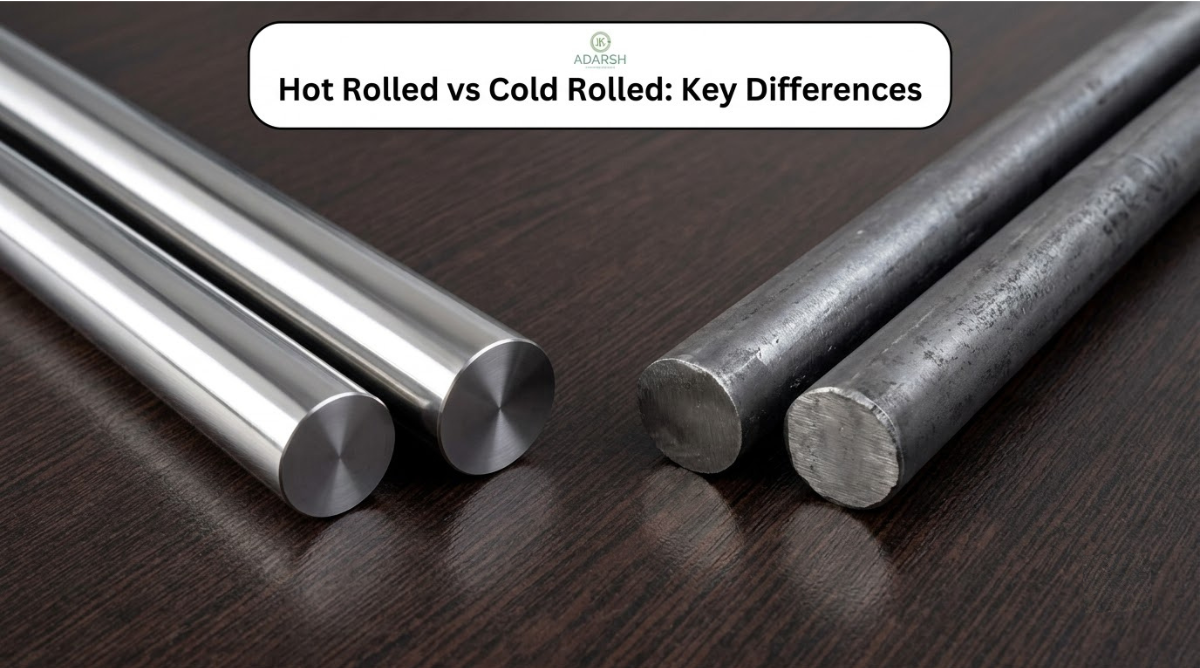
Steel buyers often assume hot rolled and cold rolled describe different grades of steel. But they do not. Both terms describe the manufacturing process applied to the same base material, and that process changes almost everything that matters to a purchase decision, like dimensional accuracy, surface finish, mechanical strength, cost, and how the material behaves during fabrication. Understanding the difference between hot rolled and cold rolled steel helps procurement teams and engineers match the right product to the right job, instead of defaulting to whichever option seems more familiar.
What is Hot Rolled Steel?
Hot rolled steel starts as a heated slab or billet, rolled above the metal’s recrystallization temperature above 900°C. At this temperature, steel deforms easily, so mills can shape large sections quickly without excessive force. Once rolling finishes, the steel cools at room temperature on the run-out table, and this uncontrolled cooling causes it to shrink slightly as it hardens.
That shrinkage means final dimensions vary more than they do with other processes. The surface also carries a rougher, scaled finish from oxidation during cooling, and edges tend to be less uniform. None of this makes hot rolled steel inferior. It simply reflects a process built for speed and volume rather than precision. The result is a material with lower internal stress, good workability, and a cost advantage that suits large structural applications.
What is Cold Rolled Steel?
Cold rolled steel begins its life as hot rolled steel. Mills take the hot rolled coil and run it through additional reduction at or near room temperature, often below 100°C. This second pass, done without reheating, is where the real transformation happens.
Working the steel cold compresses the grain structure rather than allowing it to recrystallize. Three things follow directly from this: tolerances tighten considerably, the surface finish becomes smooth and often bright, and the yield strength rises through work hardening. Cold rolled steel typically holds tolerances within fractions of a millimeter, compared to the wider variance seen in hot rolled stock. The tradeoff is reduced ductility and a higher price per unit, since the extra processing step adds time, energy, and equipment cost.
Hot Rolled vs Cold Rolled: Key Differences
The table given below helps you understand the differences that matter during procurement and fabrication planning.
| Parameter | Hot Rolled Steel | Cold Rolled Steel |
| Manufacturing Process | Rolled above recrystallization temperature, then air-cooled | Hot rolled steel further reduced at room temperature |
| Processing Temperature | Above 900°C | Near room temperature, typically under 100°C |
| Surface Finish | Rougher, scaled, matte gray appearance | Smooth, often bright or polished |
| Dimensional Tolerance | Wider, due to shrinkage during cooling | Tighter, often within fractions of a millimeter |
| Mechanical Strength | Lower yield strength as-produced | Higher yield strength from work hardening |
| Ductility | Higher, easier to bend and form | Lower, more prone to cracking under heavy forming |
| Internal Stress | Minimal, since cooling occurs gradually | Higher, from cold working, unless stress-relieved |
| Cost | Lower per unit, less processing involved | Higher per unit, due to additional rolling steps |
| Machinability | Good for general cutting and shaping | Better for precision machining and tight-tolerance parts |
| Weldability | Generally straightforward | Good, but internal stress may need relief before welding |
Typical Applications of Hot Rolled and Cold Rolled Steel
Common Applications of Hot Rolled Steel
Hot rolled steel applications concentrate in areas where dimensional precision matters less than strength, size, and cost. Structural steelwork relies on it for beams and columns, where a few millimeters of tolerance make no functional difference. Bridges and building frames use it for the same reason, along with railway tracks, which need toughness over polish.
Agricultural equipment and heavy machinery frames also draw on hot rolled sections, since these components face abrasion and load rather than close-fit assembly. Pipes and tubes made from hot rolled steel serve construction and industrial piping where wall thickness and strength outweigh surface appearance.
Common Applications of Cold Rolled Steel
The industries that require tight tolerances and aesthetics are good candidates for cold rolled steel applications. This process is crucial to automotive components, as panels and brackets need to fit to assembly perfectly. The same applies to home appliances which are also made with cold rolled sheet, coupled with the required smooth surface for painted or brushed finishes.
A tighter dimensional control applies to office furniture, precision engineering parts and electrical enclosures, where dimensional tolerances are critical to fit and safety. The remaining items feature storage systems, fabricated metal products, in which there is no need for secondary finishing because of consistent thickness and a clean surface.
How to Choose Between Hot Rolled and Cold Rolled Steel
Selection should follow the application instead of a general preference for one process. When surface finish is a priority, cold rolled steel wins outright, since it arrives smooth and ready for painting, plating, or polishing with minimal prep work.
When dimensional accuracy is critical, particularly in parts that mate with other components, cold rolled tolerances remove the guesswork that hot rolled variance introduces. Cost optimization points the other way. If the part is structural or heavy duty and a millimeter here or there doesn’t matter, hot rolled steel will give you the strength you need at a lower price per ton.
Structural performance under load, rather than appearance, also favors hot rolled sections, especially in construction and heavy equipment. Fabrication method matters too: parts that need heavy forming or bending benefit from the ductility of hot rolled steel, while components headed for CNC machining or tight-fit welding perform better in cold rolled stock, provided internal stress gets relieved where needed.
Conclusion
The decision between hot rolled and cold rolled steel depends on the actual requirement of the application: dimensional requirement, surface finish, mechanical property, method of fabrication, and budget. Both processes don’t necessarily yield the best result in every scenario. Hot rolled steel is ideal for structural and heavy duty applications where price and strength are primary concerns, and cold rolled steel is used for precision components for finish and tight tolerances. These differences can help buyers ensure the material they order is the correct one the first time, saving money and rework. Adarsh Stainless Pvt Ltd collaborates with procurement teams and engineers to ensure that the stainless steel products selected are perfectly suited for the project.